

ABOUT US
For 38 years, Service Dogs, Inc. has transformed unwanted dogs into lifelines for Texans living with significant challenges.
PROGRAMS


HISTORY
A New Life for Shelter Dogs

1988 | Attorney Sheri Soltes creates Texas Hearing Dogs with the double mission of helping people live better lives and using shelter dogs instead of breeding.
Training utilized positive reinforcement in contrast to traditional industry methods using force.
Expanding Services

1991 | After a request from an individual with a spinal cord injury, we expand to train Service Dogs. New name: Texas Hearing & Service Dogs, Inc.
We continue to provide all dogs and lifetime follow up free of charge.
Helping Child Victims

2015 | SDI introduces our Courthouse Facility Dog program to serve help our littlest victims find their voice in court.
We train them to work with Victims' Services staff within District and County Attorneys' offices. Dogs like Sumi, support children during forensic interviews and on the witness stand.
Heroes for Heroes

2018 | In response to a District Fire Chief's plea for help with first responder suicides, we created our First Responder Facility Dog program. These dogs work full time helping build resiliency among firefighters, paramedics, hospital staff and law enforcement agencies.
First responders suffer from a suicide rate 30% higher than the general public. Emergency Services Facility Dogs help destigmatize mental health.
Campus Expansion

2024 | We tripled our training staff, adopted the largest number of dogs in our history and 100% succeeded, progressing up to 6 weeks ahead of schedule.
2025 | We cut the ribbon on our new quarantine kennel built and donated by C.C. Carlton Industries. We also launched a Psychiatric Service Dog for PTSD pilot program.
Second Campus

2026 | We are raising $1.5M to establish a satellite campus near downtown Austin and the airport to train advanced dogs in metropolitan areas.
With your support, we can better prepare our dogs for clients living in big cities as well as cozy small towns!
STAFF
Sheri Soltes
Founder & CEO

Sheri Soltes founded Service Dogs, Inc. in 1988 on the concept of using dogs rescued from animal shelters. An honors graduate from both the University of Texas School of Law and the University of Texas Plan II Honors undergraduate program, she left her law practice to devote her full time to building Service Dogs, Inc. Under her guidance, Service Dogs, Inc. has led the industry in combining the use of all rescue dogs with positive reinforcement training methodology.
In 2023, Sheri served as new Chair of Assistance Dogs International North America (ADI NA). She chaired the ADI NA Legislative and Advocacy Committee from 2018 - 2022. Her work contributed to the revisions of the Air Carrier Access Act making air travel safer for passengers traveling with legitimate Service Dogs.
In 2022, she helped negotiate with Walmart and Etsy to stop selling Service Dog vests and other equipment to the general public.
Sheri has mentored assistance dog programs around the world including Australia, Japan, Spain and Chile. She has been a featured speaker at many conferences and institutions in the United States, Spain and Chile.
Sheri’s articles on the legal rights of Assistance Dog users have been published by Assistance Dogs International, the International Association of Assistance Dog Partners and Leader Dogs for the Blind. She drafted the 1995 revisions for Texas’ Assistance Dog accessibility statute.
In 2023, Austin Business Journal selected Sheri as a finalist in their Women in Business Awards and their CEO Awards. In 2022 she won an Austin American-Statesman Extraordinary Woman Award.
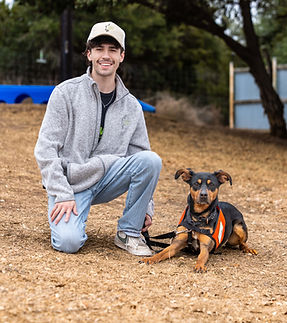
Tailer O'Neill
Chief Operating Officer &
Director of Training

Tailer got his start into Dog Training after completing a 1 year apprenticeship learning from an Animal Behaviorist in 2013. He joined the SDI team in 2023 with over ten years of training experience. He has a BA in Business Administration and Management, with a minor in Global Marketing from University of Houston and worked in healthcare for several years. He is very passionate about animal advocacy and describes SDI as his dream organization to work with as it combines his passions of helping both people and animals who need it. Tailer’s responsibilities include overseeing our campus training program, Associate Trainer Development, and shelter dog evaluations.
Fun Fact: He is also the proud adoptive parent to SDI’s mascot and demo dog – Jeep!
Trainers


BOARD OF DIRECTORS

Doug Fullerton
CHAIR
Client / Graduate -
Service Dogs, Inc.
Round Rock, Texas

VICE CHAIR
Sn. Director of Professional Services
Demandbase
Austin, Texas


Piper Browne
TREASURER
Director of Marketing
Blackbaud, Inc.
Austin, Texas

Kim Olson
Colonel, USAF, Ret.
Texas Women’s Hall of Fame
Mineral Wells, Texas

